title: "Sodium Bicarbonate 101: Chemistry, History & Everyday Safety"
slug: sodium-bicarbonate-101
primary_keyword: "sodium bicarbonate explained"
meta_description: "Take a fun lab-to-kitchen tour of sodium bicarbonate — where it comes from, how it works, and how to use it safely everywhere from baking sheets to industrial scrubbers."
recommended_internal_links:
– anchor: "bicarbonate buffer"
target: TODO:/chemistry/bicarbonate-buffer (P1C1S4)
– anchor: "Solvay process"
target: TODO:/production/solvay-process (P1C2S1)
– anchor: "baking soda vs sodium carbonate"
target: TODO:/chemistry/baking-soda-vs-soda (P1C1S5)
recommended_external_links:
– anchor: "FDA GRAS notice"
url: "https://www.fda.gov/food/generally-recognized-safe-gras/fda-gras-notice-inventory"
– anchor: "OSHA SDS database"
url: "https://www.osha.gov/sds"
Meet the most underrated white powder on your shelf
If kitchen chemistry had a superhero, sodium bicarbonate would wear the cape. The same fluffy powder we toss into banana bread also keeps municipal smokestacks in check, calms heartburn, helps dairy cows digest, and props up carbon-capture experiments. Let’s take a nerdy-but-fun stroll through how this crystalline compound is formed, why it behaves the way it does, and how to use it responsibly.
A quick timeline from volcanoes to grocery aisles
| Era | Milestone | Why it matters |
|---|---|---|
| Ancient Egypt | Natron (a mix of sodium salts) pulled from dry lake beds | First documented cleaning and embalming uses. |
| 1791 | French chemist Nicolas Leblanc commercializes soda ash | Opens the door to synthetic sodium carbonate and later sodium bicarbonate. |
| 1846 | John Dwight & Austin Church start the first U.S. baking soda factory | “Dwight’s Saleratus” kicks off household use in North America. |
| 1860s–present | Ernest Solvay refines the ammonia-soda process | Modern plants produce >5 million tons of NaHCO₃ annually. |
| Today | Food, pharma, water treatment & environmental markets | Demand grows with clean-tech and specialty-grade requirements. |
Every leap on that timeline widened bicarbonate’s orbit. Natron let ancient Egyptians preserve pharaohs; Solvay’s ammonia-soda breakthrough slashed prices and filled Victorian kitchens; modern decarbonization projects now lean on the same molecule to scrub flue gases. The through-line is simple: whenever people need a gentle, predictable alkaline helper, sodium bicarbonate sneaks onto the ingredient list.
The chemistry: NaHCO₃ in all its buffering glory
- Formula: NaHCO₃ (one sodium ion, one bicarbonate ion, one hydrogen, one more oxygen than plain carbonate).
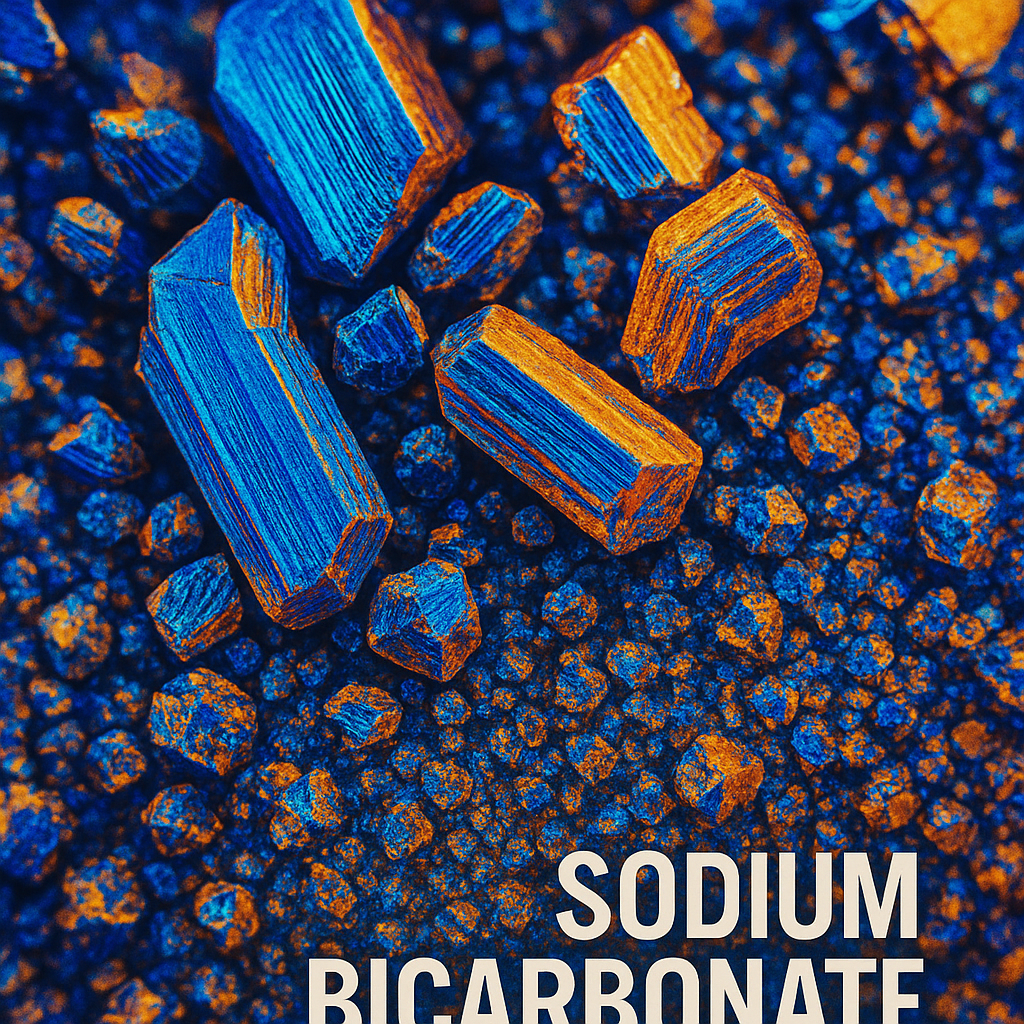
- Crystal structure: Monoclinic prisms that look like tiny rhomboids under a microscope—great for gentle abrasion.
- pH behavior: Mildly alkaline (8.3 in a 1% solution) thanks to the bicarbonate ion snagging stray H⁺ and releasing CO₂.
- Thermal decomposition: Above ~200 °C, it breaks into sodium carbonate (Na₂CO₃), water vapor, and CO₂ — the reason cookies puff and why the powder can smother fires.
Buffer superpower: Bicarbonate toggles between HCO₃⁻ and CO₃²⁻, absorbing spikes of acidity or alkalinity. That’s why it steadies swimming pools, aquarium tanks, and even your bloodstream when doctors administer IV sodium bicarbonate.
Think of each crystal as a friendly hall monitor. If too many acidic troublemakers show up, bicarbonate coaxes them into CO₂ and water; if the solution swings basic, the same ion politely dials things back toward neutral. That gentle, reversible chemistry is why formulators reach for NaHCO₃ when they need stability without scorching delicate ingredients.
Where does it come from?
- Natural deposits: Trona ore mined in Wyoming, China, and parts of Africa is refined into soda ash and then converted to NaHCO₃.
- Solvay (ammonia-soda) process: Limestone + salt + ammonia + CO₂ → sodium bicarbonate precipitate. The powder is filtered, dried, and either sold as USP/food grade or calcined further into soda ash.
- Electrochemical & carbon-capture pilots: Emerging startups bubble captured CO₂ through saturated soda solutions to precipitate NaHCO₃, aiming for carbon-negative production.
Each route determines impurity levels, particle size, and price. Commodity technical grade can land under $400/ton, while pharma grade easily crosses $1,600/ton thanks to tighter specs.
In Wyoming’s Green River Basin, for example, trona miners crush ore, dissolve it, filter away clay, and crystallize out soda ash before re-carbonating it back into high-purity NaHCO₃. A Solvay plant in Europe might instead bubble recycled CO₂ through brine in towering carbonating columns, while a carbon-capture pilot in Iceland feeds direct-air-captured CO₂ into electrochemical cells. Different journeys, same destination—a white powder with the exact behavior bakers and engineers expect.
Grades & labels decoded
| Grade | Typical Label | Key Specs | Where it shows up |
|---|---|---|---|
| USP/FCC | “Baking Soda,” “Pharma Grade” | Heavy metals <3 ppm, loss on drying <0.25% | Food, antacids, toothpaste, IV drugs. |
| Food Grade | “Cooking,” “Kosher” | Similar to USP but may skip pharma documentation | Baking, brewing, bath bombs. |
| Technical | “Industrial,” “Pool” | Wider impurity window, may include anti-caking aids | Fire suppression, flue gas treatment, detergents. |
| Specialty | “Micronized,” “Low Density” | Custom particle sizes or coatings | Tablet compression, elastomer foaming, abrasive pastes. |
Label tip: Look for lot codes plus certifications (USP, NSF, Halal, Kosher). Real suppliers list assay data (≥99.0% NaHCO₃) and moisture levels. If the bag dodges specifics, treat it as technical grade only.
The best suppliers make it easy to trace a bag back to the evaporator it came from. Ask for the certificate of analysis, flip to the moisture line, and confirm the loss-on-drying number is below 0.25% if you’re baking or formulating cosmetics. For industrial buyers, a quick impurity scan (chloride, iron, insolubles) will tell you whether the powder will play nicely with catalysts or HEPA filters.
Safety snapshot: generally recognized as safe, with caveats
- GRAS status: The FDA includes sodium bicarbonate on its Generally Recognized as Safe list when used within good manufacturing practice (FDA, 2024).
- LD₅₀ (oral, rat): ~4,220 mg/kg — fairly low acute toxicity (NIOSH, 2022).
- Sodium load: 1 teaspoon ≈ 1,259 mg sodium. People on low-sodium diets should watch cumulative use.
- Household handling: Avoid inhaling dust clouds; mild eye/skin irritation is possible. Rinse with water.
- Industrial PPE: Follow OSHA SDS guidance—safety goggles, dust mask, and vacuum (not sweeping) for spills (OSHA, 2023).
Medical note: DIY antacid shots should be limited to ½ teaspoon dissolved in 4 oz water, sipped slowly. Overuse can trigger metabolic alkalosis or sodium overload, especially in children and older adults. When in doubt, ask a healthcare professional.
For factories, the same caution translates to air handling. Keep dust levels below the OSHA nuisance-dust limits, vacuum with HEPA filters, and store pallets away from acids that might trigger premature CO₂ release. The powder is famously forgiving, but respect it like any other processing aid.
Comparing sodium bicarbonate to its cousins
| Compound | Formula | Alkalinity | Typical use | Key difference |
|---|---|---|---|---|
| Sodium bicarbonate | NaHCO₃ | Mild (pH ~8.3) | Baking, cleaning, buffering | Releases CO₂ gradually. |
| Sodium carbonate (washing soda) | Na₂CO₃ | Strong (pH ~11) | Heavy-duty cleaning, glassmaking | More caustic, no food use. |
| Potassium bicarbonate | KHCO₃ | Mild | Low-sodium baking, agriculture | Adds potassium instead of sodium. |
| Calcium carbonate | CaCO₃ | Mild | Supplements, chalk, antacids | Insoluble; doesn’t fizz. |
Use the mildness of NaHCO₃ to your advantage: it’s strong enough to neutralize vinegar but gentle enough for enamel, produce, or spa water when diluted properly.
Everyday scenarios (with science sprinkled in)
- Baking: Pair with acidic ingredients (buttermilk, brown sugar, cocoa) so bubbles release at the right moment. Too little acid = soapy taste. Blend it into dry ingredients before adding liquids and get batter into the oven fast—CO₂ starts forming the minute the crystals dissolve.
- Laundry: Bicarb grabs odor-causing acids, lowers water hardness, and boosts surfactants. Add ½ cup to the wash drum, not the detergent drawer. It’s especially helpful with gym gear and toddler clothes—let them soak 30 minutes for a deeper deodorizing punch.
- Cleaning: Make a 1:1 paste with water for scouring cookware—it lifts grease without scratching thanks to those monoclinic crystals. Add a splash of dish soap for stovetops, or sprinkle it straight onto carpets prior to vacuuming to neutralize pet funk.
- Pools & spas: Dissolve separately, then add to return jets. Target alkalinity 80–120 ppm to let chlorine work efficiently. Small daily top-offs beat weekend dumps; log each addition so you can spot trends in your source water.
- Heartburn relief: Dissolve ½ teaspoon in water. If symptoms persist, stop and consult a clinician; long-term reflux needs medical care. Never chug it dry—CO₂ expansion plus stomach acid is a recipe for discomfort.
- Fire safety: Smother small grease fires by dumping bicarb (never flour) so it decomposes endothermically and releases CO₂. Keep a canister within arm’s reach of the stove and replace it yearly so humidity doesn’t brick the powder.
Build your bicarb toolkit
Keep two containers on hand: one pristine box for culinary/personal use, and a refillable shaker for cleaning projects. Label scoops for baking, laundry, and pool care so you never cross-contaminate. Pair the powder with a stash of small glass jars—you can pre-mix deodorizing sachets, DIY scrubs, or emergency antacid packets and grab them when needed. Bonus points for logging how much you use in a simple spreadsheet; it turns “oops, we’re out” into “time to restock before the big bake sale.”
Fun lab facts to drop at parties
- Each kilogram of NaHCO₃ can neutralize about 12 moles of hydrochloric acid.
- Bicarbonate is the dominant blood buffer, accounting for ~53% of CO₂ transport.
- NASA tested baking soda for odor control on Skylab missions.
- Dairy farmers ration ~200 g/cow/day to stabilize rumen pH.
- Carbon capture researchers use NaHCO₃ slurries to scrub SOx/NOx alongside CO₂.
Responsible storage & shelf life
- Moisture: Keep sealed; the powder absorbs humidity and CO₂, slowly turning into sodium carbonate.
- Heat & light: Cool, dry pantry shelves extend potency beyond the “best by” date (usually 2 years unopened, 6 months opened).
- Testing freshness: Add a teaspoon to vinegar; vigorous fizz = active. Weak fizz = demote it to cleaning duty.
What’s next in the bicarb universe?
- Green Solvay loops: Plant retrofits capture their own CO₂ to feed new NaHCO₃ batches.
- Carbon-negative building materials: Researchers blend bicarb with aggregates to trap CO₂ in concrete.
- Food tech: Micronized USP grade improves gluten-free baking textures.
- Health & performance: Sports scientists continue to refine “bicarb loading” protocols to avoid GI distress.
Whether you’re prepping croissants or scrubbing smokestacks, the playbook is the same: respect the chemistry, source the grade you need, and let bicarbonate’s steady temperament do the heavy lifting. It’s the rare ingredient that can headline a science fair volcano in the morning and polish an ESG report by night.
TL;DR checklist
- Use USP/FCC grade for anything you eat, drink, or swish.
- Pair the powder with acids for baking drama; dissolve fully for cleaning and pools.
- Store it airtight and recycle older boxes into cleaning paste.
- When we publish the deeper dives (buffering chemistry, Solvay production, safety myths), link to them using anchors like “bicarbonate buffer,” “Solvay process,” and “baking soda vs sodium carbonate.”
Ready to geek out even more? Up next we’ll zoom into the bicarbonate buffer mechanics and tour a modern Solvay process plant—so this hub can link down to every supporting article in the 3→5→10 plan.
Image Briefs
- Microscopic crystal glamour shot
- Prompt: "Ultra-close macro photo of sodium bicarbonate crystals under polarized light, vivid blues and oranges, scientific poster vibe."
- Style: Photoreal macro photography
- Alt text: "Polarized-light view of sodium bicarbonate crystals"
- Usage: Lead image to reinforce the chemistry section.
- Cozy kitchen science flat lay
- Prompt: "Warm, inviting kitchen countertop with baking soda jar, measuring spoons, vinegar, lemon, laundry scoop, labeled cards showing uses."
- Style: Soft natural-light photo illustration
- Alt text: "Kitchen flat lay showing everyday sodium bicarbonate uses"
- Usage: Mid-article visual for the everyday scenarios section.
Internal Link TODOs
- Link "bicarbonate buffer" to the P1C1 deep-dive once that article is live.
- Link "Solvay process" to the production cluster post once published.
- Link "baking soda vs sodium carbonate" to the comparison support article when ready.
References
- FDA, 2024. U.S. Food & Drug Administration. "GRAS Notice Inventory." https://www.fda.gov/food/generally-recognized-safe-gras/fda-gras-notice-inventory
- NIOSH, 2022. National Institute for Occupational Safety and Health. "Sodium Bicarbonate (NaHCO₃) – Pocket Guide." https://www.cdc.gov/niosh/npg/npgd0550.html
- OSHA, 2023. Occupational Safety and Health Administration. "Safety Data Sheets (SDS) Guidance." https://www.osha.gov/sites/default/files/publications/osha3514.pdf
- Solvay, 2023. Solvay Group. "Sodium Bicarbonate Technical Data Sheet." https://www.solvay.com/en/document/technical-data-sheet-sodium-bicarbonate